¿what do we have to change in our apiary that the small bee
can defend herself against the diseases?
 First we want to achieve a bee that lives as natural as possible and that is strong enough to
to defend herself against all diseases.
So we cannot use any "crutches" as Dee Lusby says.
NO CRUTCHES
This means that we cannot use nothing that is not natural in the hive.
No remedies, no chemicals, no mentol, no acids, no arificial feeding, no sugar etc
Only honey, polen and wax
The bee lived healthy for thousands of years without artificial things
and since we raised the size of the bees the diseases started
and at the same time the fight against these with chemicals.
No sugar
the use of sugar debilitates the bee deeply
wax without chemical contamination you can get it in 4,9mm in: http://www.biredskapsfabriken.se/english/index.html
"Housel Positioning" - How I View It's Importance To Beekeeping!
By Dee A. Lusby
Commercial Beekeeper
Tucson, Arizona
21-22 Sep 02
Just a few weeks before this meeting, in discussion with Michael
Housel, of Orlando, Florida, I received information concerning proper positioning
of wild feral combs built by honeybees he had been monitoring and observing
in his local area hanging on limbs of trees.
Intrigued by, and recognizing the value of the information concerning the
positioning of the wild feral combs, my husband and I immediately started
incorporating the information into our field management program, by resequencing
close to 35,000 frames in our colonies, to match their positioning.
So just what is this proper positioning of feral combs Michael Housel told
me about?
It concerns understanding the "Y" formation of the pyramids formed at the
base of the wild combs, and in manufactured beeswax foundation at the base
of the cell imprints, that beekeepers place into their colonies, to help domesticated
honeybees replicate wild feral combs.
Foundation used by beekeepers is basic to field management. It is used to
stimulate domesticated honey bees to build both brood and honey combs, using
beeswax secreted from glands on the workerbee's body. It was originally copied
from wild combs in the 1800s.
The "Y" formation has been there since the beginning in the making of beeswax
foundations. It's in understanding it, and it's proper positioning and placement
that Michael Housel has recognized, and we just resequenced our colonies to
duplicate, that I hope others here today listening and learning about it,
will want to duplicate also, in their own beekeeping operations.
If you copy something exactly to use, which is the purpose of our foundations,
and then you don't use it as originally designed and placed by the bees themselves,
how can beekeepers blame bees for building and doing things wrong within a
beehive? For then in actually, it's man's improper alignments and positioning
of manufactured foundations, contrary to original natural design, that could
then be causing much of today's bee's internal problems relative to working
and drawing combs.
How can scientists do research even, with improper positioning of foundations,
not relative to actual positions in the wild? Is science, science, if based
upon an artificial world of enlargeness, and improperly positioned combs at
the same time, that matches nothing in a real world? How do you know if the
research you are doing is good or bad for what it is supposed to relate to,
if the combs in the domesticated colonies being reviewed do not match the
positioning of wild combs?
The "Y" formation
A "Y" is formed where lozenge-shaped rhombic plates come together to form
a Y impression at the bottoms of cells on beeswax foundation. The formation
of the "Y" is also seen in wild combs at their cell bases.
There is a right and left side to each foundation and comb when viewed, whether
in a man-made colony, or hanging down from a limb.
The right and left sides for facing foundation and drawn combs in a beekeepers
hive are determined by the top or bottom positioning of the "Y" formation.
This changes by either being right or left of an imaginary center line in
domesticated hives. In the wild there is one special center comb hanging down
from a limb. In our man-made hives which we call colonies this does not occur,
and so an imaginary line must be drawn and used, for positioning right or
left of center, and up or down, of the "Y" formation.
Beekeepers can easily turn a wild comb and see this. Likewise beekeepers can
turn a man-made frame or piece of foundation and see this formation also.
When wild combs are cut down, should not they be positioned in alignment like
those obtained from the wild colony, to aid the now domesticated bees placed
into a man-made hive, to continue to grow and properly expand?
If you have not seen or noticed this before, take a sheet of foundation and
put it in front of you on a flat spot to look at.
Then with the rectangle sheet of foundation with long-ways on top and bottom,
and short ways on sides, carefully look at it.
There are two ways to rotate a sheet or comb (in frame) when looking at it
to observe the "Y" formed at the bottom of the cells.
Most beekeepers are taught early on to carefully rotate a sheet or frame with
bees, from top to bottom (vertically up and down), with a twist of the fingers
and wrist, so as to disturb the bees on the comb as little as possible, to
observe the broodnest for conditions relative to disease, mites, egg laying,
and larva size, applicable for grafting.
When beekeepers rotate a frame this way, no change to the eye takes place,
though you rotate to see both inside the top and bottom of the cells. Beekeepers
are taught this motion to observe bees for various fouls, and mite fecal for
evidence of varroa present.
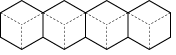
Next, with the sheet of foundation in front of you, turn the sheet NOT VERTICALLY,
BUT INSTEAD FROM LEFT TO RIGHT HORIZONTALLY!
Now, when you look at the cell bottoms with the "Y" formation it should change
from top to bottom, every time you turn the sheet over.
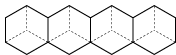
Explaining "Housel Positioning"
In the wild, there is one center frame that is first drawn when honey bees
swarm onto a limb. In spring or following normal swarming the first comb built
is worker (exception being more towards fall, following the summer solstice
and longest day, when bees swarming can sometimes want to build drone/honey
comb first to obtain stores for winter and then once a certain amount is drawn
and realized, they then start workercombs).

Now this comb is built with the "Y" inverted and upside down on both sides
of the comb. So I now type "^I^" to show the inverted "Y" on both sides of
the comb. There is only one of these combs made.
For hives that normally swarm, wanting worker larva for continuation of species,
bees need optimum cells for workerbrood immediately, especially in areas of
short flows. Hence, this specially drawn first comb.
This starts the wild nest with a center comb expressly designed for maximum
production of worker bees, that are needed immediately for continued rearing
of new brood and collection of stores, as the field force dies off.
Each comb then, on each side of the center comb follows position, for continued
maximum rearing of brood, and then collection of stores of pollen and honey,
as comb building progresses and expands the nest.
From here, the "Y" formation stays inverted first, facing center with the
"^" down. This continues formation of a slanting ledge the larva rest on,
allowing for maximum field bees to be used for gathering stores of nectar
needed for comb production, with lesser numbers of nurse bees required.
I now type "^" to show the inverted "Y" for side facing center comb (or center
of imaginary line in center of man-made colony) with slanted ledge.
On the other side of the comb the "Y" formation faces up, and helps to form
a slanted roof, to help once the bees manage to build enough comb, to protect
larva and stores gathered from sun, rain, etc. I now type "Y" to show the
"Y" right side up with roof, for side facing away from the center comb.
What beekeepers end up with then, is all foundation or combs in colony with
the "^" down formation facing towards center, and all foundation or combs
in colony with "Y" up formation, facing towards the sides of the boxes/supers,
away from an imaginary center line. I now type ^IY to show this.
Now, the combs in the center on frames are the smallest and are worker cells,
and only at the periphery of the worker cell broodnest change into drone cells.
This can be done two ways.
On either side of a good drawn workercomb you can have periphery drone cells,
including the bottoms.
Once an average of four or so worker combs are drawn on each side of the center
worker comb, beekeepers will find the next combs built a combination of drone/honey
combs. So what you are looking at in broodboxes/supers then is:
YI^,YI^,YI^,YI^,YI^,^IY,^IY,^IY,^IY,^IY
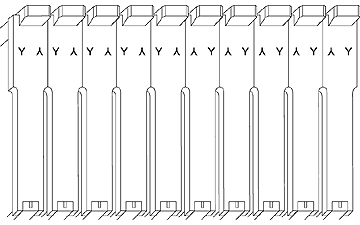
What you are looking at in wild combs hanging is:
YI^,YI^,YI^,YI^,^I^,^IY,^IY,^IY,^IY
This transition to larger starts slow but gets more pronounced the closer
to the outside of the broodnest you go across the first workercell combs built
from the center main comb or imaginary line.
On good flows, beyond this, especially in wild colonies, you can get combs
drawn with cells even bigger then drone cells, but rarely seen except in exceptional
years.
Now, the placement of these bigger combs/dronecombs on the outside periphery,
is to protect the worker combs from damage. Animals attacking a feral hanging
nest will pull off the outside larger combs for food and many times go on
after eating their fill. Wind if strong, along with rain will knock or blow/rip
down these outside combs. They are weaker combs with less wax cell walls,
and thus more easily tear loose. But, they serve to protect the inside combs,
by their side alignment and positioning, from both the elements and animals.
This then leaves the smaller worker combs safe, which can and often do, contain
honey besides pollen, as the active year progresses and brooding cuts back,
and are the strongest combs with maximum wax for strength.
The positioning of the combs in man's domestic hives should follow the above
for drone/honey cell positioning relative to worker/pollen/honey cell positioning.
All good drawn-out worker combs should be placed to center, then frames/combs
with peripheries of drone cells (not more then 10% kept), then lastly badly
drawn-out transition combs. This way, beekeepers end up with 4 good worker
combs in the center of broodboxes, and the three on each side for combinations
of combs containing worker/drone, pollen/honey storage, and only the immediate
outside frame position, for absolute hodge-podged transition cull comb, until
the beekeeper can work it up and out during routine field work, for taking
back to the honey house for extracting and recycling by melting down.
Importance of "Housel Positioning to Field Beekeeping Management
As I said earlier, intrigued by, and recognizing the value of the "Housel
Positioning" relative to wild feral combs, we have resequenced close to 35,000
frames in our colonies and will do more as we continue to work our bees. By
resequencing our combs to match wild comb positioning, final internal colony
problems relative to our honeybees drawing-out of foundation and how the bees
work the combs, appear to be lessening or stopping altogether. Much stress
seems to have been eliminated.
My husband and I manage our hives using 4.9mm small cell beeswax foundation,
with unlimited broodnest management of 2-3 deep boxes, with 1-2 deep supers
for honey production, with an overall average colony size of 4-5 deeps. We
see no problems in using 4.9mm foundation in conjunction with "Housel Positioning",
as all this does, is copy wild naturally small honeybee comb positioning found
hanging from a limb on a tree. This way, we end up with a field management
program that is biologically harmonious to wild honeybees, in both comb size
and positioning, but under man's control for production.
At the same time, by not having to use various treatments of chemicals, drugs,
essential oils, FGMO and acids for parasitic mite control, accompanying secondary
diseases and miscellaneous bee pests, we also gain clean products of the hive
to sell, and bees harmonious with Nature again that live.
Final internal colony problems lessening or stopped by proper "Housel Positioning"
following resequencing of combs have been:
1. Queens not laying in inserted drawn combs placed into the broodnest.
Many times beekeepers, as a part of field management throughout the active
beekeeping year, insert drawn combs into the broodnest for their queens to
lay in, as a means of producing more honeybees for production of products
they sell.
These combs can be dry combs or extracted wet combs. But on subsequent hive
checks, that can be days and even weeks later, the beekeeper comes back to
find the comb not used, but the combs on either side being utilized and laid
in. Loss to buildup of workerbees, necessary for production, is then the loss
of brood that could have been generated, for each 21 day brood cycle of workerbees,
not laid by the queen.
2. Excessively bulged/drawn-out honey combs with the next frame either
burred or hardly drawn. It is not uncommon for beekeepers to find bulged/drawn-out
honey combs with newly drawn-out comb 2-3 inches thick in supers with new
foundations, while the adjoining new frame of foundation next to it is hardly
touched or is burred in pattern.
Transporting such honey combs home can be trying as bumps are driven over,
that cause the frames to knock and rub together, causing the honey to run
out the bottoms of stacks of supers, before reaching the honey house and creating
messes that then need to be cleaned up.
Through observation, we now know that the foundation/frame positioning in
the super was wrong, and that the frame that was either burred or hardly touched,
next to the bulged overdrawn-out honeycomb, was backwards in position to other
combs in the honey super relative to positioning of wild combs.
3. Bees refuse to move up into next higher box/super of either drawn frames
or new foundation. While this does not happen too often on good honey
flows, on average to poor honey flows this can be a problem with bees showing
reluctance to expand up into the next higher box/super, to either fill empty
combs there, or draw-out foundation. This found happening in a few hives can
lessen workerbrood raised and honey stores gathered. Once frames are repositioned
according to the way the "Y" formation is facing, the bees move up and continue
to expand and work.
4. Odd frames of foundation not drawn and/or bees sidewinding. From
time to time beekeepers place a new frame of foundation into a broodbox or
super of drawn combs only to have their bees ignore it. Or they may have 2-3
frames of either new foundation or drawn empty combs or combination of these,
the bees seem to ignore in a broodbox/super. Through observation, we now know
the "Y" positioning of the new frame or frames was probably faced wrong, causing
the bees to go around the improper sequencing and positioning relative to
wild combs.
5. Burred foundation or overlaid foundation. From time to time beekeepers
find frames of new foundation that has been overlaid with sections of either
bigger or smaller combs drawn out. We have seen bigger drone/honey combs overlaid
on frames positioned with the "Y" formation inserted backwards. We have also
seen worker/pollen combs overlaid on frames positioned with the "Y" formation
inserted backwards. When looking at the overlaid comb, interesting to note,
is the fact that the bees in overlaying the pattern, seem to be reworking
the facing of the "Y" formation.
Many places of overlay face the same way as the foundation is placed, yet
in other areas on the overlaid face, the bees it seems, are actually trying
to reverse it's positioning to that of the foundation which was improperly
positioned. Each burr overlaid formation tells it's own little story of the
bees working it, trying to adapt the "Y" formation. This leads to much transition
comb if these frames are allowed to be continued. Our combs are more evenly
smaller now, because our bees are more uniformly maintained and bred, so we
mainly see our bees trying to determine which way to face the "Y" formation
now. Various sizes of differing transitional burr combs are not so prevalent
with cells sizes strikingly different to the eyes.
6. Transitional combs containing various cell sizes are built. Similar
to overlaid combs built upon new sheets of foundation, beekeepers can find
transitional combs being built by honeybees containing numerous cell sizes.
These cells are normally built by colonies upon foundations with "Y" formations
positioned wrong and can range up to .2mm to .3mm bigger on average.
7. Queens are suddenly raised at wrong times of the active year causing
swarming problems. Beekeepers in adding empty drawn combs or freshly extracted
wet combs into the broodnest sometimes go back and find hives requeening at
odd times of the active year. Beekeepers can also add odd frames of new foundation
into the broodnest to be drawn-out and end up with a few queens being raised
along with worker larva. They can also have changed nothing from the previous
year in the broodnest, but all of a sudden requeening starts even though they
know the queen they have is young and this should not be happening. This can
be especially frustrating when a honey flow is coming on or in progress, or
they actively follow breeding programs trying to requeen their colonies yearly
to avoid this. Why would colonies want to requeen more then once throughout
the active beekeeping year?
From what we have seen in our colonies, it is a comb positioning problem with
the frames in backwards. With the comb positioned backwards and thus out of
alignment with other combs in proper sequence, beekeepers can trigger spontaneous
requeening in colonies by failing to note which way the "Y" formation is facing.
Beekeepers must take note and remember one way the formation of the "Y" faces
is inverted and down "^", creating a ledge for larva to lay upon that honeybees
use for fast build-up following swarming, etc.
On the other side of the comb and/or foundation, the "Y" formation faces up
and helps to form a slanted roof, to protect larva and stores gathered from
sun, rain, etc. But, the slanted roof of the "Y" formation facing up has another
purpose in a colony! For it is only on the side where the "Y" formation faces
up, and helps to form this slanted roof, that honeybees raise "queen cells"
that face downward for requeening.
Therefore, beekeepers not positioning foundation and drawn combs properly
can spontaneously trigger superceding, and thus swarming in their colonies.
With hives under stress already from disease, pests (beetles), and predators
(mites), besides often on programs of various treatments for same, improper
positioning then takes less effort to trigger problems, one of which can be
spontaneous requeening.
Whose fault is it then! The bees or the beekeepers, for not following proper
"Housel Positioning" for sequencing of managed colony combs, relative to proper
positioning of wild combs?
One last note, in going back to colonies that were resequenced with proper
"Housel Positioning" of frames, the disposition of the bees was noticed to
be gentler then before.
